Saturday, 17 September 2016

East Mids Exploration: Day 17

We were up fairly early this morning, and set off a little before 8am. There's not really much to say about the retracement of our steps along the Nottingham Beeston Canal. At Beeston Lock, the rise up to the River Trent was again just a few inches. Along the next stretch of the Trent, there are some quite nice looking houses, all of which seem to have a boat outside as well. You can seen how much the river floods, as the houses are up on stilts.

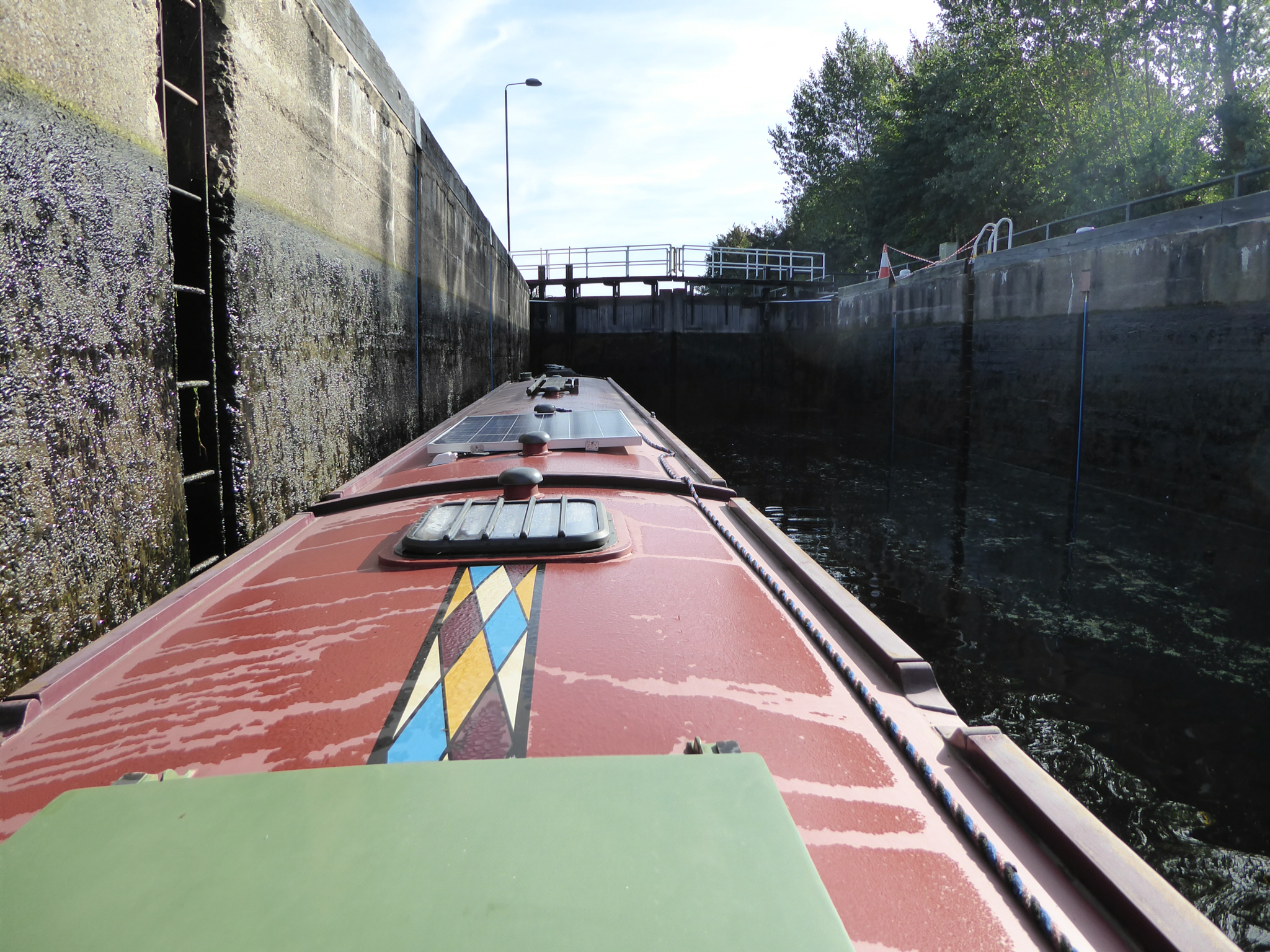
As we approached Cranfleet Lock, there were again volunteer lock keepers on duty, who prepared the lock for us, gave us a green flag, took our ropes when we were in, and worked the paddles. It's quite a deep lock.

The Cranfleet Cut is a little over half a mile of straightness, which ends at the big junction with the Trent, the Soar, and the Erewash Canal. It's a week since we were last here; then we were going from the Erewash to Cranfleet Cut, this time is was Cranfleet to the Trent. We're now on waters we last did three years ago, although in the opposite direction. On one side of the river there's a Scout adventure centre, with lots of tents and lots of kids (and quite a few adults) in lots of boats.

At Sawley, we decided we'd take the right hand channel where there's a full range of services. So we were able to fill with water, get rid of rubbish (there are even recycling bins), and I did an empty of the composting loo. I'm getting good at this now, so it didn't take too long.

We were stopped for half an hour or so. We needed to turn around, then go back through the railway bridge, then turn again to get into Sawley Lock. A couple of boats had not long come down, and there was a volunteer lock keeper on duty, so we could go straight in. We made a further brief stop outside Sawley Marina, as we need diesel. But if you don't want to use the automated system (which does a 60/40 split on propulsion/domestic), their attitude seems to be that it's really too much bother. So we decided to go elsewhere. We'll stop at Mercia Marina tomorrow instead.

The next stretch is back on the Trent again, going under the M1 and then a much more impressive water pipe.

Derwent Mouth Lock takes you up onto the Trent and Mersey Canal, and we had to queue for a lock for the first time since Foxton (and I don't really count queues at Foxton and Watford, because the staircases mean there's nearly always a queue). Next comes Shardlow, with some attractive buildings.

We shared Shardlow Lock with a Kate hire boat from Warwick doing the Leicester Ring. We told them we did that ring on a Kate Boat ten years ago. By Bridge 7a there's a tree down, giving just enough room to get through. It looked like a crack willow -- and I thought they were supposed to have been dealt with, following an incident a few years ago when a boater was swept off her boat by a willow which happened to crack and come down as she passed underneath.

One of the following bridges has suffered quite a lot of damage, with half the parapets gone, and big cracks elsewhere. The farmer or someone has decided to prevent further damage by installing barriers on the bridge.

There's a nice looking church near Weston, and before Swarkestone you can see the Swarkestone Hall Pavilion, or The Stand, which is available for holidays.

We carried on through the deep locks at Weston and Swarkestone, and moored above Swarkestone -- where we moored three years ago. It's been a funny sort of day weatherwise -- dull, not very warm, and with brightness always just on the horizon, but never getting any closer.

Once I'd written this blog, the engine was cool enough but still warm enough, so I did an oil change which was a few hours overdue.

19 miles, 8 locks. (275 miles, 132 locks)


Friday, 16 September 2016

East Mids Exploration: Day 16

There was a fantastic sunset over Gunthorpe Bridge last night.

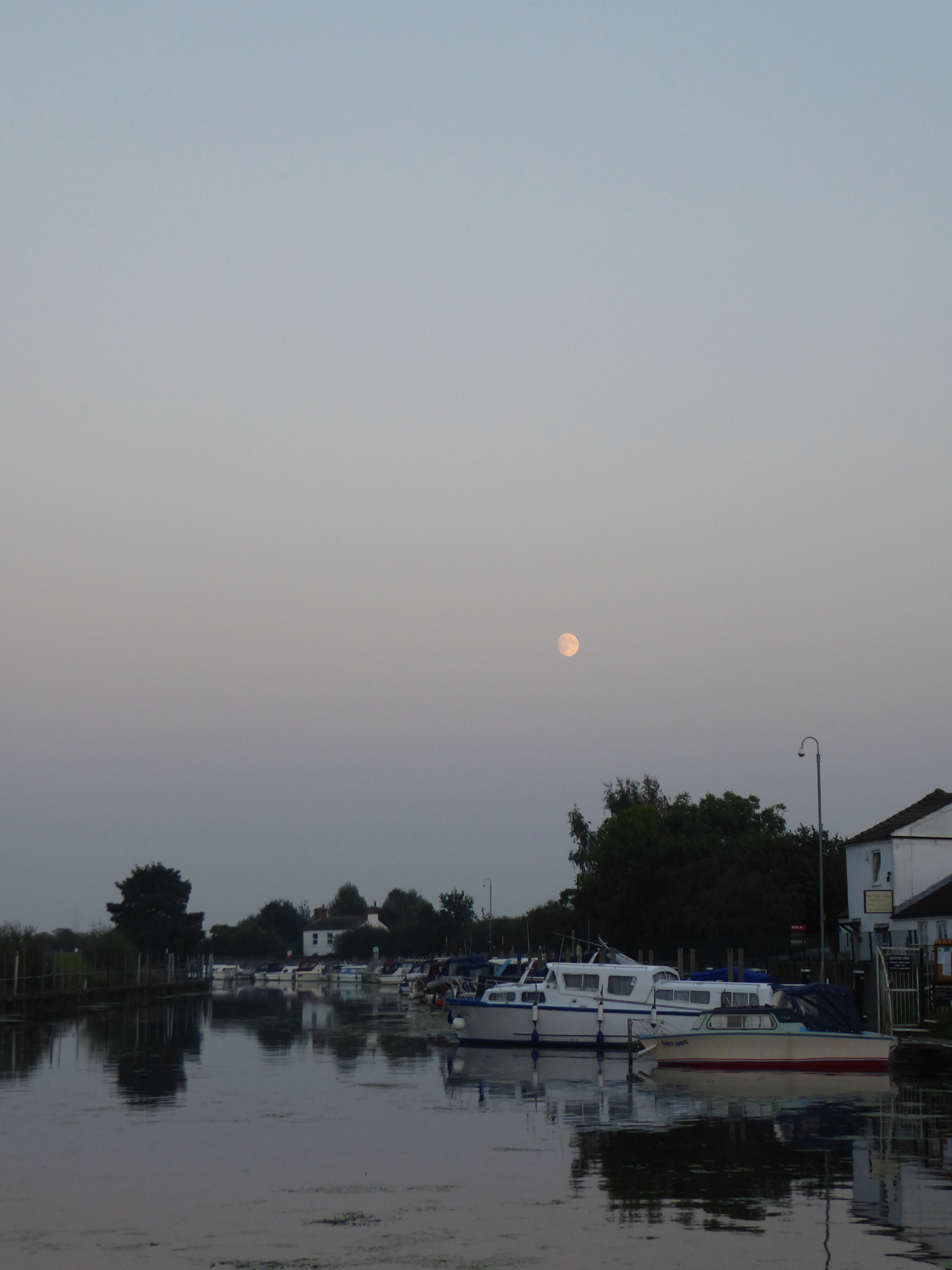
Then an hour or so later, at the stern of the boat, there was a beautiful moon.

This morning was anything but beautiful. There was rain, which was heavy at times. Every now and then there appeared to be a lull, but then the heavy stuff returned. Having done so many miles yesterday, we were content to sit it out. Then as lunchtime approached we could see the end of the cloud. We decided to go over to The Unicorn pub just over the road for an earlyish lunch, then set off. So we were underway at 1pm. It was turning sunny up ahead, but still really dark behind. There was plenty of water coming into the river from a stream near Stoke Bardolph, and the swans appeared to be enjoying the ride (or the food).

The VHF radio proved invaluable again today. The two Trent locks we did were both against us until I radioed a few minutes before we arrived, and by the time we got to them, they were open and ready for us. The lock keeper at Stoke Lock said it had been the quietest day this month! The approach to lots of these locks going uphill can be tricky, because of all the water coming over the weirs. At Holme Lock, there's the weir stream coming in from one side, and the end of the white water course at the Holme Pierrepont watersports centre coming in from the other.

Holme Lock is deep -- the lock keeper said that with summer river levels, the rise can be up to 18 feet. When the lock is full, it holds a million gallons of water.

Our next lock, we had to work ourselves. It's the one up from the river to the Nottingham Beeston Canal. Then we did one more lock before mooring in central Nottingham, just a few boat lengths from where we were last Saturday. We had planned to go further, but the lunchtime start put paid to that. We made use of the very nearby Sainsbury's to stock up for a few days.

11 miles, 4 locks. (256 miles, 124 locks)


Thursday, 15 September 2016

East Mids Exploration: Day 15

The problem with needing to go on a river in the fairly early morning in the autumn, is that it'll be misty. And it was this morning. In fact, it was a bit more than misty in places. We needed to set off at 7am to catch the tide; the visibility wasn't great.

The conditions meant a great deal of concentration was needed. We were following the charts, and to make sure we knew where we were and where there were shallows we needed to avoid, we needed to look out for the red and green markers on the corners, the km posts, and the warning signs.

After a while, I noticed that emerging out of the gloom behind us was a large boat. We recognised it as the tug, Exeter, pushing a couple of huge empty pans. They'd all been on the pontoon at Torksey Lock. Then I noticed that a small cruiser we'd met at Torksey was also behind us. They came past first.

Exeter gradually caught up with us, and at a suitable point we slowed down and let it pass.

Then some boats appeared coming the other way. First were three cruisers, then a bit later a narrowboat. We also heard on the VHF radio the Cromwell Lock keeper telling Torksey the names of the boats heading his way. It confirmed my belief that you shouldn't pick a silly name for your boat, because it may need to be used on the radio. One of the cruisers was Vino Collapso.

The VHF proved very useful as we approached the end of the tidal section at Cromwell Lock. Exeter told the lock keeper he was on his way, and that he had us behind him. He said he'd need to use the whole lock -- rather than the middle gates on the lock, which they'd use for narrowboats and cruisers -- and suggested we go in first, with him behind. So on the approach to the lock, Exeter slowed down, we went past into the lock, and then he came in behind us. We've shared locks on the Thames with some big boats, but nothing like this.

Egrets: I've seen two. One in the gloom this morning, another after the sun came out this afternoon.

We carried on through Nether Lock and Town Lock at Newark, each time using the VHF to tell the lock keepers we were coming. We had lunch on the move, then at some point in early afternoon the sun finally burned off the mist and fog. The reach up to Fiskerton seemed to take ages, but once we got there, there's plenty to appreciate. We liked a modern riverside house, and the pub looks good too.

It was now nicely sunny and warm, so we carried on, aiming for Gunthorpe Lock. The scenery does look different going the other way, but as we did the river only the other day, it did seem sensible to try to get plenty of miles under our belt. We moored up for the night at the visitor pontoons at Gunthorpe at about 4.30. I'm not sure we've ever done this many miles in a day before.

36 miles, 5 locks. (245 miles, 120 locks)


Wednesday, 14 September 2016

East Mids Exploration: Day 14

We had a very quiet night in Lincoln; those moorings might be a bit different next week when all the students are back for Freshers' Week. This morning was misty and murky. With very few miles to do we were in no rush to get going, but set off about 9.15 on the return trip along the Fossdyke Navigation. The first landmark outside Lincoln is the Pyewipe Inn, seen here yesterday when it was sunnier.

We stopped half way along the navigation at Saxilby, where there are good visitor moorings. We'd been warned by a boat going the other way about some anglers there; they were on the offside, and took vocal objection to any boats passing too close. We walked into the village and found a decent Co-op. Saxilby has a heritage society, and the more interesting buildings have little plaques on them. We did a circular route round the village to get back to the boat, where we had lunch. Setting off again, there was a man in the water by the railway bridge. I asked him what he was doing, and he said he was checking the bridge hadn't been undermined in any way.

Before long the cooling towers of Cottam power station came into view. By now the sun had burned off the mist and it was getting warm again. We moored on the visitor moorings before Torksey, as the tides mean we can't go down the lock until the evening.

We moved to the top of the lock later in the afternoon, then at a bit after 7pm we were called to go into the lock. There was a lovely moon over Torksey Basin.

One of the sets of centre gates at Torksey Lock has been filled with tea pots. There are more all along a wall by the cafe, too.

By 7.30 we were tied on the pontoon below the lock. We'll need to set an alarm for the morning. We are taking the tidal Trent back to Cromwell Lock, and will have to go with the tide -- which means setting off at about 7am. Particularly having read tonight's blog by Sue on No Problem XL, once we'd moored up I checked the weed hatch, and removed a few handfuls of weed from around the prop shaft.

11 miles, 1 lock. (209 miles, 115 locks)


Tuesday, 13 September 2016

East Mids Exploration: Day 13

The Fossdyke Navigation is one of the least interesting bits of waterway we have ever travelled. In the eleven miles between Torksey and Lincoln there are maybe half a dozen bends; such are the long straight sections, that when a boat passes going the other way you can often still see it half an hour later.

We started a wash load, then set off just before 9am on a lovely bright sunny morning. After an initial rural section of waterway, the Fossdyke is then accompanied by roads right alongside, or a railway, or both. After about three hours we arrived in Lincoln. We decided to go through Brayford Pool, with its rather smart waterfront.

At one corner of the pool the River Witham goes off, with a narrow channel leading up to Lincoln's most famous waterways feature, a bridge known as the Glory Hole.

There are moorings the other side, in the middle of a shopping centre, but we decided to go back to the moorings on the other side of Brayford Pool, so we turned just above Stamp End Lock and returned. The moorings are next to student halls, a building site, and a big road bridge, so not exactly picturesque. It was lunchtime, so we went for lunch at a pub by the Pool, then walked up the old part of the city, by the Cathedral and Castle. Steep Hill isn't called that for nothing! It's hard work getting up there -- particularly as the day was now very hot, but the reward is the massive Cathedral, which is spectacular, and the surrounding streets which are lovely.

We didn't pay the £8 each charge to go inside. Instead we went to Lincoln Castle, where the grounds are free, then paid to do the walk round the walls, which offer some of the best views of the Cathedral.

We could also see Cottam Power Station, back beyond Torksey Lock, and more than a mile to the south the new memorial to Bomber Command, Britain's tallest war memorial.

The Castle grounds include the courthouse and jails of various eras. After tea at the Castle cafe, we wandered back down the hill, stopping at a great ice cream shop on the way, and returned to the boat.

So while the journey to Lincoln may not have been anything special, the city itself is well worth a visit.

12 miles, 0 locks. (198 miles, 114 locks)


Monday, 12 September 2016

East Mids Exploration: Day 12

A quiet night in Newark, the only disappointment being that the castle wasn't floodlit; maybe the lights have fallen victim to cuts or something. This morning was bright and sunny again. We started a wash load, then set off at about 8.15, under Newark Bridge.

Nether Lock was showing an amber light which means boater operation, so Adrian went and pressed the buttons. It's another big and fairly deep lock.

It's a few miles from Nether Lock to Cromwell Lock, where the Trent becomes tidal. As we approached the lock a couple of narrowboats were coming out, the lights changed to green, and two small narrowboats went in -- so we followed them. One was a little Sea Otter, the other looked like an ex-Canaltime boat; I asked the helmsman if he was an old hand at this, and he said he'd been doing it about thirty-five years. As we left the lock, a big cabin cruiser was waiting to come in.

We followed the other boats, but also had the Trent charts, which I'd laminated and put in a file. The charts show the line of the channel, all the red and green markers on the corners, and the numbered kilometre posts, so you know where you are. There are a couple of places with big yellow warning signs, advising of sunken islands that need to be avoided.

There are a few landmarks, like a disused jetty not far from Cromwell, a topless old mill, and eventually even a bridge or two.

About three quarters of the way through our journey, we thought the boat in front was a bit far over to the right, where the chart showed the channel more in the middle of the river and then moving left. Moments later, the water round the boat went muddy, and he was aground. We asked if there was anything we could do help, and the helmsman said he was ok -- but he looked to be pretty well stuck to us; we were also a bit concerned about getting stuck ourselves. His mate was way ahead, but he must have phoned him because he later turned around and went back. I doubt he'd have been able to do anything, not least because the tide was still going out. All you can really do is wait for the next tide to lift you off.

We carried on and eventually came to the entrance to Torksey Lock Cut. I started making the turn, only to find a dredger with a huge pan right in the middle of the cut. I signalled to the operator to ask which side I should go, and he indicated to the right. There wasn't much room, and the tide was also trying to sweep me past, but we got through the narrow gap between the dredger and the trees without touching anything and without getting stuck. This is looking back, with Cottam power station in the background.

It had taken us just under three hours from Cromwell to Torksey. We moored up on the pontoon below the lock, and chatted to some of the other boaters there. There were three boats, all due to head off to West Stockwith, the start of the Chesterfield Canal, at about 1pm. One of the boaters said he's been doing the Trent for twenty years, and also ran around recently in about the same place as the boat this morning. We went to see the lock keeper, and tried to get some lunch -- but the cafe doesn't open on Mondays or Fridays, the restaurant was closed, and so was the pub. So we came back to the boat for lunch.

We had a bit of a wait -- the lock keeper said there wouldn't be enough water to get us over the cill of the lock until about 5pm. When there was enough, he'll open the lock and turn the light to green. During the afternoon, I've done some more work on my boat test, Adrian has been reading, and a tug called Exeter has brought a huge empty pan for the dredging operation and took away a full one after turning round right next to us -- coming within inches of the boat.

At about 6pm, we got the green light for the lock. Torksey is a big lock, with a couple of sets of middle gates that don't seem to be used. There were three boats to go up; this one was behind us.

The lock keeper said we could moor above the lock, once the four boats waiting there had gone down.

23 miles, 3 locks. (186 miles, 114 locks)


Sunday, 11 September 2016

East Mids Exploration: Day 11

A fantastic day's boating today in really nice sunshine. We had a quiet night on the Nottingham moorings and set off at about 8.15 -- exactly the same time as the boat moored in front of us, called The Sergents' Mess. We were to end up sharing all seven locks today. The first of them was just a few minutes away, Castle Lock, and shallow at just 4ft 6in.

After passing some impressive new buildings, the canal takes a right angle turn, before arriving at Meadow Lane Lock, which takes you down onto the Trent. Our companions moored up briefly below for breakfast, while we turned right to go under Trent Bridge, and have a look at County Hall.

We did a U-turn and began our journey downstream. As we approached Holme Lock the traffic lights changed from red to green and we could go straight in. We'd seen that The Sergents' Mess was a little way behind us, so told the lock keeper, who waited for them. The lock is big, and quite deep.

At each lock the lights changed for us, the gates opened, and we could go straight in. All the lock keepers were friendly, and our descents were uneventful. After each lock, the river seemed to change character: sometimes with wooded sections, sometimes with cliffs on one side, and sometimes with lovely big skies.

We passed a whole range of different boats during the day, from a big trip boat near Newark, to cabin cruisers, rowers, and sailors.

There are a few settlements along the river. Fiskerton is one of the prettiest.

We had lunch on the move, as we passed Staythorpe power station.

At Newark Lock, we had to wait for a big plastic boat coming up.

I asked the lock keeper on our side of the lock if she happened to know how busy the moorings were. She said the boat that had just come up had said the pontoon after the bridge was busy, but the wall opposite the castle was clear. So we moored on the wall -- the land is the same height as our roof, but we are positioned with a ladder at the well deck and the stern; we have a fantastic view from the side hatch, but looking back from the bridge we look tiny!

We went for a walk round Newark, which being Sunday afternoon was mostly closed. But it does have so,e impressive buildings around the market square, and we had a choice of cafes for tea and coffee.

We walked back to the river, and diverted to have a look at the pontoon mooring. Our companions from today had got a space, but the outlook isn't anything like as impressive as where we are. We then walked along the opposite side of the river, below the castle and bumped into the sailors we'd passed earlier, who'd stopped for tea. We then cross the lock and returned to the boat. There's a blues festival in the castle ground this afternoon, so we've had a musical accompaniment, but it's all due to finish by 6pm.

24 miles, 7 locks. (163 miles, 111 locks)